
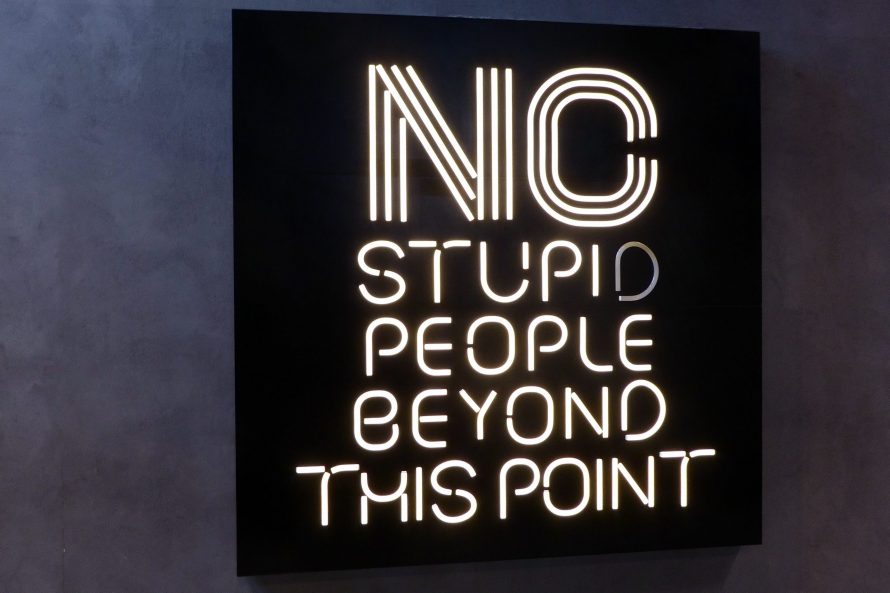
If you are the leader, ultimately only you know what is important to your company. It’s your job to ensure everyone else has the knowledge to do their jobs. If you are at the bottom of the corporate ladder it’s your job to ensure you apply your knowledge, skills and experience properly to support the business’ goals.
The job of a Scrum master is to ensure his software development team has all the tools they need to complete the sprint at hand, and clear away (or at least minimize) the obstacles that impede them from doing their job. The developers need to be able to trust their Scrum master to do this, to feel safe that their lack of ability to complete a sprint is not going to be some mental block. If the project owner is rag nagging on a particular developer, who then feels threatened about his ability to compete the job, it’s the Scrum master’s job to diffuse the situation.
Failure is just a learning experience. It should never be a bruise to the ego.
The same is true of knowledge management (KM). You expect some level of expertise knowledge from your team members. But you also expect transferability of knowledge from one team member to another, and to have cross training so that team members can cover each other in case of vacation or unexpected absences. And to be self-sufficient in case your manager goes on extended leave. Unexpectedly. Not knowing when she’ll return. Out for nearly an entire month.

If you are an expert at something and you need to teach it to a newbie, there are going to be some important things that you take for granted because it’s become so automatic to you, but there’s no way that the newbie is going to know of it in advance. But it is an important step. If you don’t try to bridge that gap then don’t expect the newbie to do for you either because they don’t know what they don’t know. You’re going to have to try to coax it out of them and find a place where you’re both going to have to find that middle ground.
There are some times and subject matters where this is absolutely crucial. I can get to step 1.9.9 but never quite at step 2. Approaching but never quite achieving that asymptote. What is that crucial ingredient that I as a newbie need to get there, that the expert is not giving me. They just expect me to know?
Can’t we just meet in the middle?
When my niece graduated from high school, with aspirations to become a teacher, I told her this: The best teachers are not necessarily experts of what they teach. The best teachers have experienced the struggles of learning and understanding the subject matter, and finally overcame them. They understand what their students are going through because they’ve lived it themselves. She is now a teacher, and she won teacher of the year at her school.
Is a university professor here to teach you? Probably not. Most of them want to research… or rather, make their cadre of grad students do their research and they take the credit for themselves. A teacher that nurtures knowledge cultivation wants her students to be successful. If only a couple of students fail the test then maybe only these particular students are having issues. If all but a couple of students fail the test, then maybe there’s something wrong with the way she’s teaching the subject matter. A business that cares wants its employees to be successful. Oh, wait, isn’t that what the HR department is supposed to be for?
“Ignorance is bliss.” Ever heard of that? I’ll admit to not being as thorough as I probably should be, as far as researching in the KM arena. But if I had gone into depth, I could have picked up the ironic bias of the curse of knowledge, perhaps unwittingly modeling my marketing towards executives and KM enthusiasts, instead of targeting the deep experts with whom I worked side by side in the business trenches.

My father did his best to shield me from harmful childhood superstitions, saying it’s best never to become aware of these things in the first place. There’s nothing scientific about the simple statement of black cats bringing bad luck, but if you keep telling your kids that black cats are bad luck, then you’re priming them to expect bad luck whenever they encounter a black cat. Can you see how this can be harmful?
I pride myself on learning about knowledge management almost entirely on raw experience. I’ve done it my entire life, ever since I was literate, only recently realizing it was knowledge management the whole time. By initially ignoring what other KM businesses are doing, I can fully focus on my brand of KM without their expert bias tainting me too badly. And I’ve come to similar conclusions. I’ve seen the market need directly. On the job site, and off the job. At my parents’ house. At their friends’ places.
And I’ve seen it online…. boy does it scream online!
People I’ve talked to recognize a need for what I do, even if they have no clue how to express it. People in my online network are intrigued to learn more. I am an independent consultant with no interest to climb the steep corporate ladder, so I have few preconceived biases of what deep experts and others in the lower rungs of the corporate ladder need to be effective in the knowledge management arena.
Note that I didn’t say, “I have no biases,” as that would have been an outright lie.
I don’t let a KM expert tell me that. Fundamentally, I am just like you, one of you deep experts, somebody who has quality knowledge, wisdom, skill and expertise in some specific topic that adds value to a business. And I do have these in other areas besides knowledge management (see my curriculum vitae).
The only difference is that I am a KM enthusiast (can’t you tell I love this subject) and other KM businesses mostly ignore you, ultimately dumping that responsibility on your executive teams while they try to sell their technology. Executive teams don’t have your unique spectrum of deep knowledge, wisdom, skill and expertise. And you probably don’t have a KM enthusiast in your own team championing the cause. So you’re lost without any idea of how you’re supposed to contribute positively to your business’ KM agenda.
And the beautiful thing about practicing KM the way I do it, it feeds my desire to learn something new. You can be a teacher to me. If you are a golf equipment manufacturer, I may incidentally learn something about how to choose the right club for each game situation, how to properly practice my swing, what are the characteristics of a good golf instructor to train and coach me. (And I don’t even play golf, but I’m willing to learn.)
Caution: ignorance in some subject matters isn’t bliss. It could be perilous. Just like my disclaimer says, always consult with the appropriate professional (deep expert of his/her respective area of knowledge and wisdom) who is qualified to discuss those matters.
Got anything to uncover my blind spots, please post in the comments. Knowledge is power. Please share responsibly.